Agentic commerce: when your API becomes the storefront
Over the 2025 holiday season, traffic sent to US retail sites by AI assistants grew 693% year over year; in the first quarter of 2026 it was still up 393%. More importantly, that traffic now converts better than average: by March 2026 it was converting 42% better than classic sources, after converting 38% worse a year earlier (the Adobe Analytics figures). In plain terms: the agent-assisted shopper is no longer a conference curiosity — it is a growing channel, and the 2026 holidays will be the first where it truly counts.
Behind that shift sits a year of infrastructure work: two open protocols, backed by the industry's largest players, are standardizing how an agent discovers an offer, builds a cart and pays. For teams that invested in headless and composable architecture, it is both a validation and a new work stream.
Two protocols, one idea
ACP (Agentic Commerce Protocol). Published on September 29, 2025 by OpenAI and Stripe, it powers ChatGPT's Instant Checkout: opened first to US Etsy sellers, then extended to more than a million Shopify merchants (Stripe's announcement). Payment relies on a Shared Payment Token scoped to one merchant and one amount: the agent passes the order along without ever seeing card data. The spec is public (agenticcommerce.dev) and does not force a change of payment provider.
UCP (Universal Commerce Protocol). Announced on January 11, 2026, co-developed by Google and Shopify with Etsy, Target, Walmart and Wayfair, and endorsed at launch by more than twenty players — including Visa, Mastercard, American Express, Adyen and Stripe (Google's announcement). It covers the full journey — discovery, cart, payment, post-purchase — and is designed to work with existing building blocks: MCP, A2A and the AP2 payment protocol. Its spec is public too (ucp.dev). In April, Amazon, Meta, Microsoft, Salesforce and Stripe joined its technical council; announced in May, Google's universal cart and UCP checkout have been rolling out since the summer in Search and Gemini, with Nike, Sephora, Target, Walmart and Wayfair among the first merchants.
What it changes in your architecture
Headless separated the storefront from the engine: your interfaces consume APIs. Agentic commerce goes one step further: a third party you do not control becomes the client of those APIs. Concretely, in UCP:
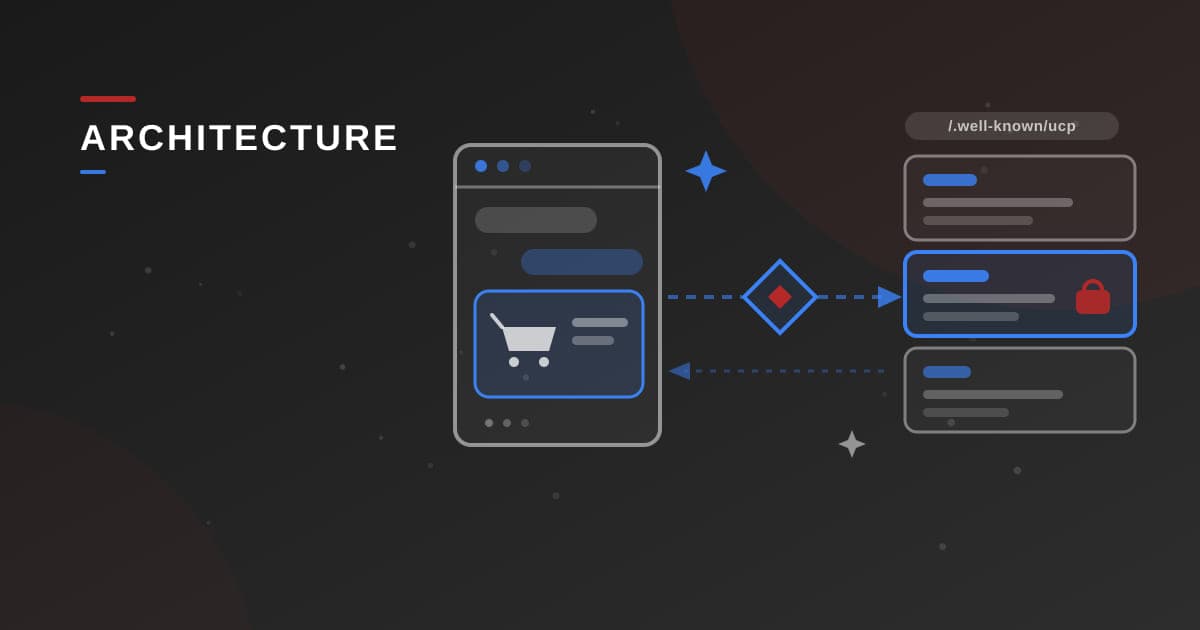
- the merchant publishes a capability profile at a well-known address on its domain (/.well-known/ucp); agent and merchant negotiate the intersection of what both support;
- checkout is an explicit state machine — incomplete, escalation required, ready to complete — with a human hand-off: when the agent gets stuck (age check, sizing, delivery question), it hands the customer a URL to finish manually;
- payment is negotiated dynamically based on cart and country, inside a delegation framework that caps what the agent may spend.
The consequence is easy to state: from the agent's point of view, the quality of your transactional APIs is the quality of your store. A poorly structured catalog, a cart that cannot be created without a browser, pricing rules buried in the theme: so many aisles invisible to this channel. Conversely, MACH / API-first architectures already tick most of the prerequisites — the composable bet is being validated, provided you cleanly expose what was not exposed yet.
Where to start, without a rebuild
- Measure what is already arriving. ChatGPT / Gemini / Perplexity referrers in analytics, agent user-agents in the logs: set the baseline before the fourth quarter.
- Make the catalog machine-readable. Structured data, clean feeds, complete attributes: the protocols consume what your data offers — nothing more.
- Inventory your transactional APIs. Can an authorized third party check price and stock, build a cart, pay and track an order today — without a browser? Every "no" is a step to climb.
- Revisit the anti-bot policy. Blocking all non-human traffic indiscriminately now means turning away customers; shopping agents and scrapers need different treatment.
- Watch your platform and the specs. UCP and ACP are public; Shopify, PSPs (Stripe, Adyen) and vendors are integrating fast. Check what your stack ships natively before building yourself.
Keeping perspective
These protocols are less than a year old; rollout is US-first (expansion to Canada, Australia and the UK has been announced), governance is still moving, and the channel remains small in absolute volume. Nothing justifies a rushed replatform. The direction, however, is settled — when Google, OpenAI, Stripe, Shopify, Amazon, Microsoft, Visa and Mastercard agree on shared rails, the question is no longer if, but when. The architect's reflex: treat the agent as a first-class sales channel, and bring your APIs up to the standard you already hold your storefront to.
I can help you.
Let's discuss your project.